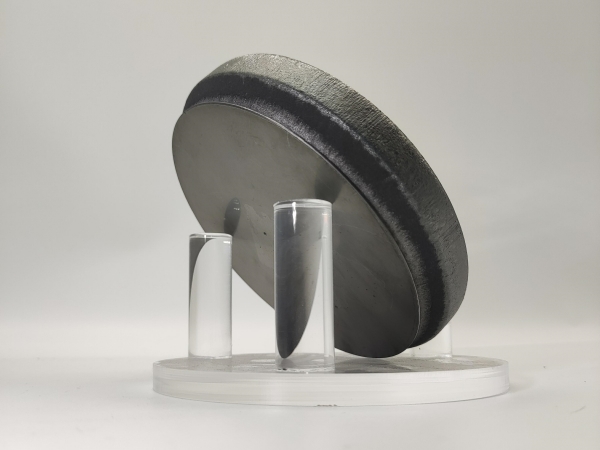
A Comprehensive Explanation of Primary Flat and Secondary Flat
As power electronics and wide-bandgap semiconductors continue to advance, silicon carbide (SiC) substrates have become essential materials for electric vehicles, photovoltaic inverters, high-voltage power supplies, and RF devices. Among the many parameters of a SiC substrate, the flats—directional edges on the wafer—play a critical role in semiconductor manufacturing and automated processing.
For 2–4 inch SiC substrates, the industry widely adopts two flats, namely:
Primary Flat
Secondary Flat
This article provides a systematic explanation of why two flats are necessary and how they function in actual production processes.
1. Definition of Primary Flat and Secondary Flat
Primary Flat
The primary flat is used to identify the
crystal orientation of the
SiC wafer.
In 4H-SiC and 6H-SiC, the primary flat corresponds to a specific crystallographic direction (e.g., <11-20>), serving as the reference for all orientation-dependent fabrication steps.
Secondary Flat
The secondary flat is used to distinguish:
Conductivity type (N-type / P-type)Polytype (4H / 6H)Its position relative to the primary flat is defined by SEMI standards, enabling automated equipment to quickly recognize wafer properties.
2. Why Do 2–4 Inch SiC Substrates Require Two Flats?
1. Precise Crystal Orientation Recognition
Hexagonal SiC (4H-SiC, 6H-SiC) exhibits high crystallographic symmetry. A single flat may not be sufficient to prevent orientation misalignment.
However, crystal orientation is critical for SiC device fabrication, such as:
Trench orientation in MOSFETs
Ion implantation direction
Identification of Si-face or C-face
Wafer dicing direction
The primary flat provides a precise orientation reference to avoid directional errors during processing.
2. Differentiation of Conductivity Type or Polytype
The conductivity type (N-type or P-type) directly impacts:
Epitaxial growth parameters
Doping conditions
Device threshold and structural design
According to SEMI standards,
the location of the secondary flat varies depending on conductivity type or polytype, allowing automated systems to correctly identify the material.
This is crucial for epitaxy suppliers, wafer fabs, IDMs, and packaging facilities.

3. Compatibility with Small-Diameter Wafer Processing Equipment
Compared with larger wafers, small-diameter equipment (legacy CVD epitaxy tools, ion implanters, CMP tools, etc.) relies more on
flats rather than notches for alignment.
Thus, two flats provide more reliable orientation recognition, reducing alignment errors and ensuring stable processing.
As the industry moves toward 6-inch and
8-inch SiC wafers,
single-notch designs are becoming the norm.
However,
for 2–4 inch SiC wafers, dual-flat configurations remain the mainstream standard.
4. Preventing 180° Misalignment During Processing
With only one flat, the wafer could easily be placed in the reverse direction on automated tools, causing complete inversion of processing orientation.
Dual flats ensure correct placement and alignment throughout the manufacturing line.
3. SEMI Standards Define Flat Positions
The SEMI (Semiconductor Equipment and Materials International) standards specify:
The crystallographic direction associated with the primary flat
The angular position of the secondary flat for different material types
Flat lengths and identification conventions
These standards allow wafer manufacturers and equipment suppliers to maintain consistent, industry-wide wafer recognition systems.
Conclusion: Dual Flats Are Essential for Small-Diameter SiC Wafers
In summary, the two-flat structure on 2–4 inch SiC substrates exists because:It provides an accurate crystal orientation referenceIt differentiates conductivity type or polytypeIt meets the alignment requirements of legacy processing equipmentIt prevents directional misalignment during fabricationIt complies with SEMI international standardsDual flats enhance process accuracy and stability while ensuring consistency in SiC device performance.

About JXT Technology Co., Ltd.
JXT Technology Co., Ltd. supplies:Silicon carbide (SiC) substratesSapphire wafersQuartz wafersSilicon wafersWe are committed to providing high-performance, high-reliability crystalline materials for power electronics, optoelectronics, and semiconductor manufacturing, supporting customers in achieving superior process stability and yield.
For more information or custom specifications, please feel free to contact us.