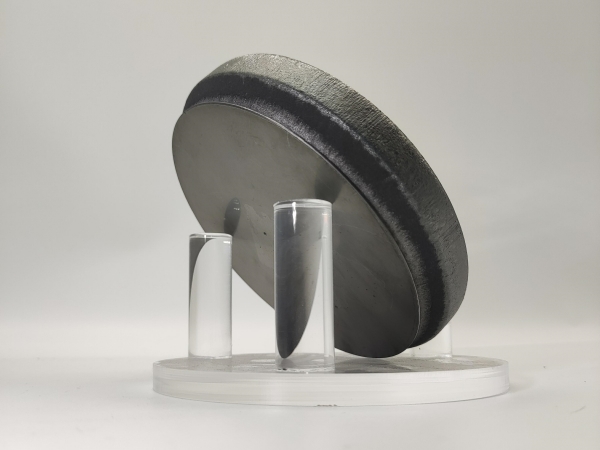
In GaN-based LED devices, sapphire substrates (Al₂O₃) are the most widely used epitaxial substrates. However, conventional flat sapphire wafers face intrinsic challenges such as lattice mismatch with GaN and limited light extraction efficiency. To overcome these bottlenecks, Patterned Sapphire Substrates (PSS) and their derivative technologies have become key solutions for enhancing LED performance.
This article provides a comprehensive overview of sapphire substrate patterning, including the processing principles, structural design, and impact on LED performance, as well as introducing Micro-Patterned Composite Substrates (MMS).

1. Overview of Patterned Sapphire Substrates (PSS)
A
Patterned Sapphire Substrate (PSS) is produced by fabricating periodic micro- or sub-micron structures on a flat sapphire wafer using semiconductor processing techniques such as
photolithography and etching.
Since 2008, PSS has been applied on a commercial scale. Currently, over
99% of GaN LED epitaxial wafers utilize PSS.
Microscopic structure of a PSS wafer:(Illustration or SEM image of microstructured surface)
| Feature |
Description |
| Structure Size |
Micro- or sub-micron periodic patterns |
| Common Shapes |
Cones, truncated cones, pyramids, dome-like structures |
| Application |
GaN epitaxial growth; improves crystal quality and light extraction efficiency |
2. The Necessity of Patterning
LED efficiency depends on
Internal Quantum Efficiency (IQE) and
External Quantum Efficiency (EQE).
Improving IQE:GaN growth on sapphire suffers from lattice mismatch, generating numerous dislocations. PSS patterns can
bend or block dislocation propagation, reducing strain and non-radiative recombination, thereby increasing internal quantum efficiency.
Improving EQE:The refractive index difference between GaN and free space leads to total internal reflection at the GaN/sapphire interface. PSS introduces surface roughness and periodic structures that
scatter trapped photons, allowing more light to escape and improving light extraction efficiency.
Illustrations: • Dislocation propagation: Flat wafer vs PSS
• Light extraction: Flat wafer vs PSS
3. PSS Structural Design
PSS structure design directly influences LED performance. Common design strategies include:
| Type |
Shape |
Features |
| Protruded |
Dome, truncated cone, pyramid, truncated pyramid |
Enhances GaN crystal quality; reduces dislocation density |
| Recessed |
Pits, inverted cones |
Modifies light propagation paths; improves light extraction efficiency |
• A 4-inch PSS with a 3 µm pitch contains approximately
1 billion microstructures • In 6-inch production, the number of microstructures exceeds
2.25 billionEach microstructure acts as a “barrier” during GaN growth, enabling adjacent GaN crystals to merge uniformly and form a complete, high-quality GaN buffer layer, enhancing IQE.
4. Key Advantages of PSS
4.1 Improved GaN Crystal Quality and Reduced Dislocation Density
Periodic structures bend or block dislocations, making epitaxial layers more uniform.
Illustration: • Dislocation propagation in flat wafer vs PSS
4.2 Enhanced Light Extraction Efficiency
PSS increases the GaN/sapphire interface area and provides angled scattering surfaces, reducing total internal reflection and enabling more photons to escape.
Illustration: • Light trapped in flat wafer
• Light extraction improved with PSS
4.3 Optimized LED Emission Spatial Distribution
Patterned structures improve the angular distribution of emitted light, providing
more uniform luminous intensity, which is critical for lighting, backlighting, and display applications.
Illustration: • LED light distribution: flat wafer vs PSS
5. Micro-Patterned Composite Substrates (MMS)
MMS is a novel substrate that combines sapphire with additional composite layers (e.g., AlN, SiO₂, SiC) and applies patterning to create periodic microstructures.
Features: • Surface composed of multiple material layers forming periodic microstructures
• Refractive index contrast can be tuned to optimize light extraction and directionality
• Ideal for high-performance LED applications requiring
enhanced light efficiency and beam direction controlMMS Illustration: • SiO₂/Al₂O₃ composite periodic structures
• Enhanced axial light emission compared to conventional PSS
6. Summary
Patterned
sapphire substrates (PSS) and micro-patterned composite substrates (MMS) offer significant advantages for GaN-based LEDs:
| Advantage |
Function |
| Improved crystal quality |
Reduced dislocation density; enhanced IQE |
| Higher light extraction |
Reduced total internal reflection; increased EQE |
| Optimized emission distribution |
More uniform light intensity; better beam control |
| High-end application support |
MMS enables tailored light directionality for advanced LED applications |
Through PSS and MMS technology, LED chip efficiency, brightness, and light quality are significantly enhanced, driving the
high-performance and large-scale manufacturing of GaN LEDs.
If desired, this article can be further enhanced with
visual diagrams for:
• Dislocation propagation (flat vs PSS)
• Light extraction comparison
• Emission distribution maps
• MMS layer schematic
Such visuals increase readability, attract technical customers, and improve SEO ranking on company websites.